
Markets Drop on Conflict, but History Favors the Patient Investor
InvestingThrough the end of February of this year, US stock markets were basically flat (up 0.7%), and international and emerging market stocks were off to a strong start (up 9.9% and 14.4%, respectively). That was before the bombing started. The US and Israel launched strikes on Iran, and Iran responded with strikes on US and Israeli targets and several neighboring countries.
With concerns about instability in the Middle East and the closure of the Strait of Hormuz, global stock markets declined. In March, US equities dropped around 5%, and international and emerging market equities each dropped about 11%.
We’ve Been Here Before
Nobody knows how this conflict will play out, but we can look to past military conflicts to gauge how global markets react in such times. Sadly, we have almost 100 years of conflicts to review.
The folks at Avantis Investors looked back at the US (left table) and international/emerging stock market performance (right table) in periods following the start of various conflicts. Specifically, they looked at performance for the three months, one year, and three years following the start of these major conflicts.
I find the results surprising.
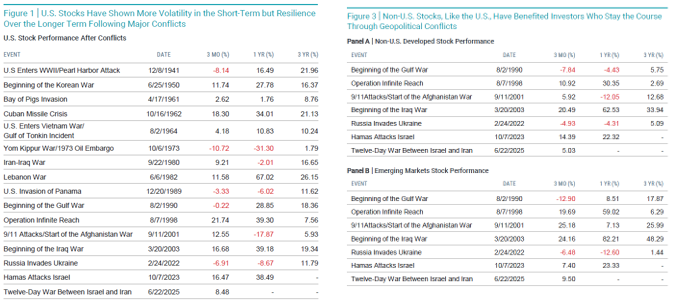
All of these major conflicts were scary and disruptive (in many ways). If we focus solely on stock market performance, we can see the three-month performance ranged from -11% to +22%, with about half of these periods showing positive performance. As expected, the markets showed higher short-term volatility as investors assessed the impact of these events.
Over the one-year timeframes, we see performance ranging from -31% to +82%. Again, more than half of these periods had positive performance. For the most part, the periods with larger losses corresponded to times when these events occurred during periods already showing economic weakness (for example, around the 1973 oil recession or the bursting of the “dot-com” bubble).
Interestingly, there were no three-year periods showing negative performance after these events. Performance averaged over 14% annually, which is well above average. Long-term investors were rewarded for not making any changes to their strategy.
Avantis shared an additional chart showing long-term stock market performance, with key military conflicts noted. Over the last 100 years, markets have been resilient despite the many military conflicts we’ve seen. I think this says a lot.
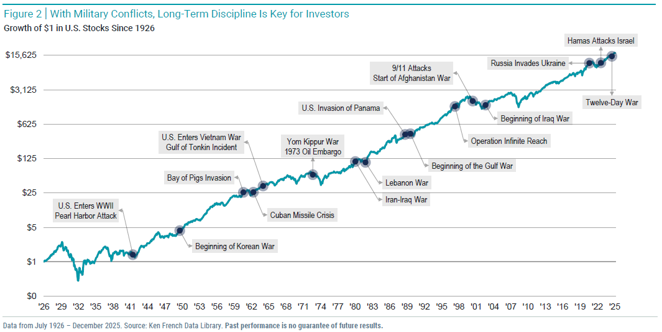
Of course, history is only a guide, not a guarantee, but it’s a useful reminder of how markets tend to behave when uncertainty spikes. Periods like this feel different in real time, and the urge to react is strong, but the evidence consistently points to patience being the better approach. We have navigated wars, crises, and shocks before, and while the path is rarely smooth, long-term investors have generally been rewarded for staying the course. The headlines will change, as they always do, but a disciplined investment strategy shouldn’t.